
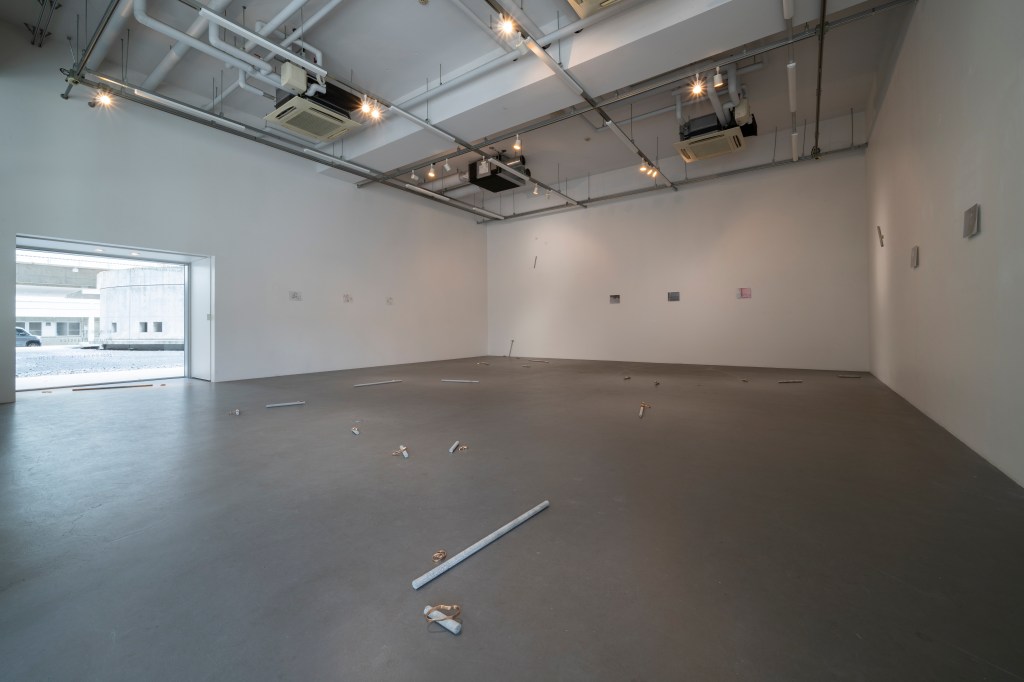
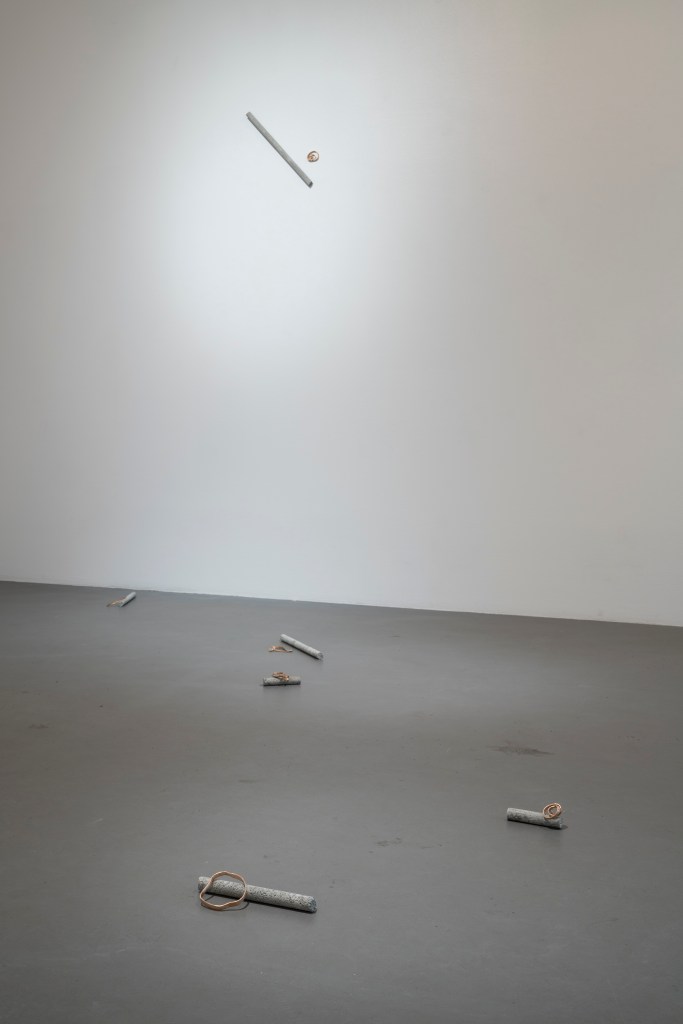
Installation size flexible
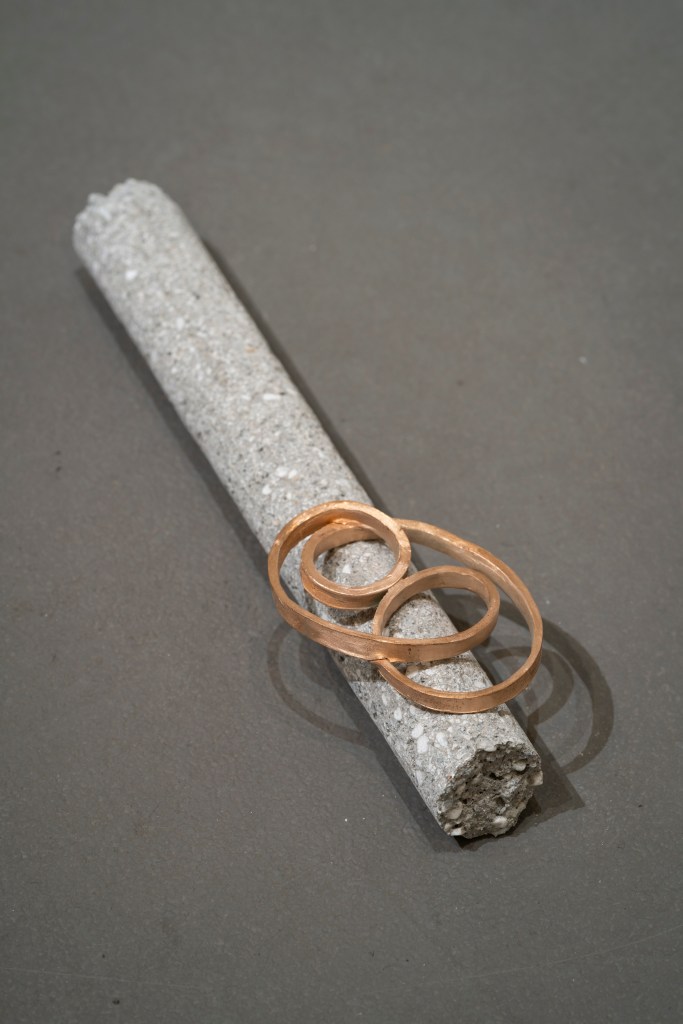
Bronze, Cement, Gravel
Venue : gFAL, Musashino Art University
Exhibition : “Loose Elastics”
2025
On the streets of the American city where I was staying, I often found various kinds of trash—or things that could not quite be called trash—scattered along the roads. One day, I suddenly noticed the presence of rubber bands lying on the ground.
Every lost object implies the existence of someone who lost it. These rubber bands must have slipped, perhaps unknowingly, from someone’s hand or body and fallen to the ground. When I imagined that, they no longer appeared to be mere litter, but rather traces of human activity—intimately connected to the gestures and movements of daily life.
People tend to consciously or unconsciously let go of everyday objects once their purpose has ended. In urban life especially, both people and objects are in constant motion; the small act of “dropping” something happens repeatedly, leaving behind countless traces across the city. As I walked the same streets day after day, sometimes I would find a rubber band in the same place as yesterday, while other times it had quietly disappeared—carried away by wind, rain, or cleaning. Amid the restless passage of urban time, these rubber bands faintly yet unmistakably visualized the natural flow of time.
Once released from their original function, the rubber bands were freed from physical constraint, transforming through small, gradual changes on the ground into “free forms” born by chance. Their distortions and twists each had their own rhythm, resembling small drawings inscribed on the pavement. I decided to record these appearances through photography. For me, photographing them was an act of capturing the moment and place where I encountered them—a way to observe not just a collection of records, but also the rhythms and traces of the people living in that city.
私が滞在していたアメリカの街の道には、さまざまなゴミや、ゴミとは言いきれないものが落ちていました。ある日ふと、路上に落ちている輪ゴムの存在に気がつきました。
落とし物には、必ず落とした誰かがいます。輪ゴムも、いつのまにか誰かの手や身体から離れ、気づかぬうちに地面へとこぼれ落ちたのでしょう。そう想像すると、それはただのゴミではなく、人の営みや身体の動きと深く結びついた、日々の活動の痕跡として立ち現れてくるように思えました。
人は、日用品の役目が終わると、それを意識的にも無意識的にも手放してしまいます。とくに都市生活では、人や物の動きが流動的で、「落とす」という些細な行為が日々繰り返され、その痕跡が街のあちこちに散りばめられています。また、同じ道を何度も歩くなかで、昨日見た輪ゴムが今日も同じ場所に残っていることもあれば、いつのまにか風や雨、あるいは清掃によって静かに姿を消していることもありました。都市の時間がせわしなく過ぎていくなかで、道に落ちている輪ゴムの存在は、淡く、しかし確かに、自然な時間の経過を可視化するものでした。
役目を終えた輪ゴムは、物理的な束縛から解放され、地面の上で小さな変化を繰り返しながら、偶然そこに生まれた「自由なかたち」へと変化していきます。その歪みやねじれは、それぞれ異なるリズムをもち、まるで地面に描かれた小さなドローイングのようでもありました。 私は、こうした輪ゴムの姿を写真によって記録することにしました。それは、私がこの都市で活動するなかで「それに出会った」という時間と空間を切り取る行為であり、ただの記録の集積から、その場所に暮らす人々のリズムや行動の痕跡を観察する試みでもあります。



 AI SUGIURA